How the era of automated “knowledge” is degrading our capacity for insight.

(read posts and access the audio version on my Substack, Unsevered)
In 2018 I began to hear a fairly clear voice in my head that sounded different from the cacophony of my own thoughts. It was steady, certain, and came from somewhere that I couldn’t readily locate.
It didn’t sound like my fears or anxieties. It wasn’t parroting my nagging and habitual talking points. It was unfamiliar but more sure of itself than any inner monologue I’d ever encountered.
The first two times I noticed it, the voice delivered an unsettling warning about something ominous that might take place. In the first instance, I ignored the voice, went forward with my plans, and suffered some pretty devastating consequences. But the second time I heard that sharp and steady voice, I heeded its caution and changed my plans. I will never know what could have been that day, but things were happily uneventful (even if I felt ridiculous about it).
Both of these instances were delivered as a single matter-of-fact sentence that cut through my own mundane consciousness.
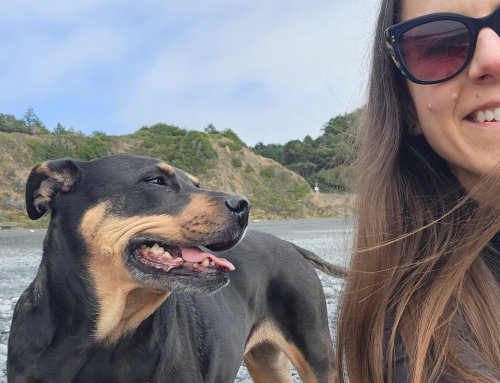
In 2025, by the time my dog Phoenix was dying of bone cancer, the voice had evolved into a vivid capacity to see thoughts and images, little messages from the universe, visitations from death itself. Because of this, I knew how much time I had left with her, exactly. I knew what path to take with her treatment. And I knew when she was ready to go.
The knowing function.
This knowing that I had cultivated over the years is a function of intuition. Intuition is not magical, superfluous, fake, or otherworldly. And it’s not something reserved for the witches and oracles of earlier eras. Psychiatrist C.G. Jung described intuition as one of the four primary psychological functions of human consciousness alongside thinking, feeling, and sensation.
Intuition is a source of spontaneous wisdom, insight, and possibility. Psychiatrist and Jungian analyst John Beebe calls it the “knowing function,” as a way of perceiving what is (similar to sensation). In contrast, thinking is regarded as the “understanding function,” with its capacity to judge and rationalize. Imagine intuition as the raw data of psyche, experience, and soul. Thinking will organize that data; feeling will evaluate its meaning or morality.
But there’s a reason you might hear my intuitive experiences and think “that’ll never be me” or “I can’t do that” or even, “that’s not real, she’s crazy.”
American culture has an overdeveloped and domineering thinking function, an underdeveloped and untrustworthy feeling function (think cults of belief and diplomacy-by-mood-swing), and a preoccupation with sensation as a means to an end.
Intuition, on the other hand, is submerged deep in the unconscious of the American psyche as a suspicious threat to our preference for rational thinking. Our access to intuition is obscured, which means that not only is our capacity for spontaneous wisdom and insight often limited, but so is our ability to trust it when it appears.
How many times have you heard or felt a bit of truth, but you wrote it off reflexively?
As a result of this alienation from intuition, we are told we must work tirelessly for our knowledge.
The incessant mental chatter of the western mind mirrors our need to investigate, probe, prod, and really “put our minds” to something in order to “know” that thing. We ask a lot of questions, but rarely do we tune in and listen. We are marvelous explorers at the edges of discovery, but this preoccupation with conquest and seeking fills the spaces where brilliant minds have made extraordinary “lightbulb” discoveries—no, not discoveries, realizations. Albert Einstein was notorious for viewing intuition as foundational to scientific advancements, above and beneath logic or analytical thinking. Intuition is the nature of epiphany. Of those flashes that seem to only come when we’re in the shower.
The guru in the machine.
An obscured intuitive capacity is tricky, too, often leading us astray because we don’t know how to consciously use it.
A result of this strained and mistrustful relationship with intuition is that we are more inclined and willing to give over to someone else’s authority, someone else’s inner “knowing” in place of our own. As inheritors of the Western mind, we are avid seekers and cosmonauts in an ongoing quest of the frontiers of knowledge, but we have suffered the loss of connection to deep insight and inner wisdom, even instinct. This tends to leave us unanchored—bodyless heads—especially when we’re in search of ourselves.
And so, we look for our intuitions within the insight and directives of others.
We’ll rightfully suspect something is amiss in our medicines or our food supply, and then give over that kernel of insight to smooth-talking charlatans who coopt our intuitions into misguided and conspiratorial but profitable paranoia.
We hope that the therapist or psychic—or the guy live streaming on Instagram about the nervous system or relationships or sex or money or astrology—might be able to tell us something about ourselves that we’ve lost touch with. We hope they have a little key that will unlock the corridor between who we are and who we think we’re supposed to be. We hope they hold some mysterious secret about us, and we will pay a premium to have the answers revealed… asap.
But anybody who has encountered this type of work will know that the witness can only access the wisdom that you, yourself, already harbor. The power of a witness is in guiding the process of self-revelation, not in prophecy.
Consciousness and New Age movements in the United States have a rich history of sketchy and subversive leaders posturing as all-knowing holders of inner wisdom. When we begin to look for ourselves, to individuate or develop psychologically, an immense amount of bewilderment and discomfort can ensue. In a world where efficiency, convenience, and now automation is increasingly valued, our tolerance for the friction of self-discovery—of challenging conversations and embarrassing but revelatory mistakes—has eroded.
We are thus inclined to turn inner work into outer work.
To farm out the diligent tending that fosters our humanity to “seers” who might see us instantaneously and provide a shortcut. And nowhere is this becoming more prevalent than in our use of AI tools like ChatGPT, Claude, and Google’s Gemini.
In the same way that we’re willing to trust the oft-wrong hallucinations at the top of a Google search rather than reading and researching the organic results below, we’re inclined to bypass the process of cultivating and tending to our frustrations, inadequacies, and misgivings by leaning on ChatGPT. More and more, people are looking to this obsequious plagiarist that will immediately quell their anxieties—anxieties that are needed to fuel the fire of human creativity and cultural progress.
When we give the work of consciousness over to AI, we flatten the emotional landscape of our lives and we squash the friction and fire necessary for societal progress. But we also stop listening. And we lose that already weakened signal to ourselves, our desires, our insights and that small still voice within that simply knows which way to go, how a family member feels, what not to say, when to leave, and what we truly need.
It’s so much easier to have a chatbot affirm or refute our inclinations and hunches rather than take the extraordinary risk of trusting ourselves, and maybe getting it wrong.
Googling for the ending.
Although we might look for our lost intuitions in our gurus, therapists, lovers, and psychics—and while we might project onto those people something we must encounter within ourselves—there’s still friction in the process. This is a feature of human life, not a design flaw.
We have to wait. We have to pay. We have to book. We have to speak awkwardly. We have to consider our timing, our words, our efforts. To consider the other’s feelings and responses. We have to tolerate being witnessed in our messy humanity.
But the insidious thing about all the world’s data at our fingertips in the form of some “all-knowing” brain is that the friction is gone. We can give over our capacity for insight, wisdom, and learning without much thought, and in nanoseconds. There’s no inherent waiting period to use Chat or Claude or an AI chatbot to tell us what to do, how to feel, what to say and when. The window of self-reflection is collapsed.
It’s like Googling the ending of a harrowing film in order to bypass the tension of not knowing. Without intuition, we ache for swift resolution, and we reach for simple answers.
But the payoff is so cheap when we know what’s coming. The process is the point.
The great impatient killer of insight.
Right before Phoenix was diagnosed, I had endured my own two-year health crisis. In the psychological agony of not having a diagnosis or a plan or even an outcome, I gave over my own intuitive capacities time and again. I heard one thing; I did another out of sheer desperation.
Early on I handed an embarrassingly exorbitant amount of money to a “functional medicine” doctor promoting peptide therapies and high-dose supplements as cure-alls for long covid and fluoroquinolone medication injury. I gave him and so many others my intuitive capacity regarding my healing. Time and again, these approaches pushed me further into symptom flairs and prolonged my recovery.
In my western thinking attempts to solve and fix the incredible pain I found myself in, I overrode the moment-to-moment voice that said wait, stop, listen. I kept acting, pushing, fighting, reading, digging. I was using the same thinking that got me into that crisis to get me out of it.
Impatience is a force that will crush intuition. The impulsive need to know will obscure our capacity for knowing. The anxiety that comes from discomfort will steer us to entrust those who say they have the answer with unreasonable confidence, including (and exceedingly) our technologies, devices, and AI.
Impatience disconnected me from my inner authority.
But by the time Phoenix was diagnosed, I knew how to slow down my entire conscious reality and tune into a wisdom that exists beyond the rational evaluative mind. As a result, she was granted a dignified final four months of the most humane care I could have provided, and we were both spared unnecessary suffering
Walking the treacherous fires of initiation hones our intuition into a voice we can hear and trust. There are no shortcuts. Every choice and every crisis presents another opportunity to become familiar with that voice, and to distinguish it from fear. What intuition has given me is a sense of indestructibility through a relentless connection to a consciousness that is not just mine, but is the substrate upon which we all walk, think, love, feel, create, and die.
There are no shortcuts to intuition. It is a real thing. And you are entirely capable of it.
Until next time,
Erika
Erika L. Raney, Ph.D.